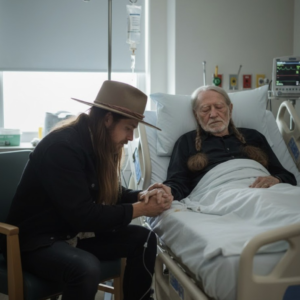
When Lana entered the hospital room, the woman stood up slowly. Her hair was tangled, her face pale, but her green eyes were unmistakable. “You got old,” Nora whispered, tears sliding down her cheeks.
“Do you remember me?” Lana asked, her voice trembling.
Nora nodded. “You had chickenpox. You were supposed to come too.”
Lana sat beside her, stunned. “They told me no one would remember,” Nora whispered. “That no one would come.”
“Who told you that?” Lana asked gently.
Nora looked out the window, then back. “We never made it to Morning Lake.”
The following days were a blur of investigation and revelation. Forensics found no remains inside the bus, but they unearthed a wedge photo behind a panel: a group of children standing in front of a boarded-up building, their faces blank. In the shadows behind them, a tall, bearded man.
Nora, still fragile but lucid, remembered fragments: the bus driver wasn’t the usual one. There was a man waiting at a fork in the road. “He said the lake wasn’t ready for us yet. That we would have to wait.” She remembered waking up in a barn with covered windows and clocks that always read Tuesday, even when it wasn’t. They were given new names. “Some of the others forgot their home,” she said. “But I didn’t. I never did.”
Lana followed clues to an abandoned barn on County Line Road, once owned by a man named Avery. There, she found a child’s bracelet in the brush belonging to Kimmy Leong, another of the missing children. Inside, the walls were carved with children’s names, some shallow scratches, others deep and angry. In a metal box, she found Polaroids of the children, not posed but candid: sleeping, crying, eating. Each had a new name on the back: Dove. Glory. Silence.
That night, Lana sat with Nora and showed her the photo from the bus. “This was after the first winter,” Nora said softly. “They made us pose once a season to show progress. That building is where they kept us the longest.”
A search led Lana to Riverview Camp, a former summer retreat purchased in 1984 by a private trust. There, she found the building from the photo. Outside in the dirt were fresh, small footprints of a child. Inside, a boy no older than ten, pale and thin, called himself Jonah. He didn’t remember his real name. “They took it,” he said. “Are you here to take me away?”
Lana brought Jonah to the station. He recognized faces in the yearbook: Marcy, Sam, Lana herself. “You were supposed to come,” he said. “That’s lucky.”
Meanwhile, forensics found another photo in the bus: four children around a campfire, one with dark skin and short hair. “He stayed. He chose to stay,” the note read. Lana traced the name to Aaron Develin, who now lived quietly in town. When confronted, Aaron confessed: “Not everyone wanted to leave. I was the one who stayed when others tried to escape. I believed in it for a long time.”
Aaron led Lana to the ruins of the original sanctuary, where the children were first taken. There, beneath a collapsed beam, Lana found a package: a cassette player, a bracelet, and a child’s drawing: “We are still here.”
Aaron pointed to a second trail. “That’s where they moved the younger ones after the fire. They didn’t call it a sanctuary anymore. They called it Haven.”
Following the map, Lana found a hidden hatch in the roots of a lit cedar tree. Below, a tunnel led to a network of rooms: bunk beds, drawings on the walls, and a central chamber with fifteen desks. In the center, a locked case held a curriculum: “Obedience is safety. Memory is danger.”
In a sealed room, Lana found hundreds of photographs and a mural of a girl running through the trees: Cassia, a name repeated in notes and logs. Cassia, it turned out, had survived, living under a new identity as Maya Ellison, a quiet woman who ran the town bookstore. When Lana showed her the mural, Maya wept. “I thought it was a story I told myself. I never believed it was me.”
Three survivors—Nora, Kimmy, Maya—reunited. They spoke of the others, of erased memories and forgotten names. Some had died, some had run, and some, perhaps, were still out there, waiting to be found.
A new sign stands at Morning Lake now: “In memory of the missing. To those who waited in silence, your names are remembered.” And in the quiet, the town of Hallstead County breathes again, knowing that some stories, no matter how deeply buried, will always find their way to the light.