She sent Miles a five-paragraph email accusing him of abandoning family, being controlled by me, humiliating his sister, destroying his mother’s reputation, and allowing “mountain resentment” to poison his values.
Miles forwarded it to his therapist, not me.
Then he sent Patricia one reply.
Mom,
I will not attend any event where Avery or Marian are expected to absorb disrespect for the sake of appearances.
If you want a relationship with me, you can begin by writing a specific apology to Marian and Avery without defending yourself.
Miles.
Patricia called him eleven times.
He did not answer.
I read his message three times when he sent it to me later.
Not because it was perfect.
Because it existed.
Sometimes love returns first as documentation.
Patricia’s apology arrived in January.
It was not good.
Dear Marian and Avery,
I regret that certain seating decisions and remarks at Natalie’s wedding were interpreted as hurtful.
I stared at the first sentence for so long my tea went cold.
My mother took the letter, read it, and said, “This is not an apology. It is a weather report blaming the umbrella.”
I laughed for a full minute.
Miles did not laugh when I told him.
He sounded exhausted.
“I know.”
“What did you say to her?”
“I told her it was not specific and not acceptable.”
“And?”
“She said you and Marian are enjoying punishing her.”
“Are we?”
“Are you?”
I thought about it.
“No,” I said. “I am enjoying not rescuing her from consequences. It feels different.”
“It is different.”
Patricia tried again two weeks later.
This time, the letter was handwritten.
Marian,
I seated you near the kitchen because I believed you were unimportant to the room. I disguised that belief as event planning. I made comments about your town, clothing, and background because I wanted to remind Avery that our family outranked hers. I was wrong.
Avery,
I treated you as if marrying my son gave me authority to judge the place and people who made you. I used politeness to make cruelty harder to name. I am sorry.
Patricia.
It was better.
Still not enough.
But better.
My mother read it twice.
Then placed it on the kitchen table.
“She had help.”
“Probably.”
“Good,” Mom said. “People who need help apologizing should get it.”
That was my mother too.
Merciless and generous in the same breath.
Spring came.
I returned to Charleston for a weekend.
Not to the Whitcomb house.
To Miles’s apartment.
It was small by his family’s standards, which meant normal by everyone else’s.
One bedroom.
A balcony overlooking a parking garage.
A kitchen with two pans and a coffee maker he did not know how to clean properly.
It smelled like laundry detergent and new beginnings.
He had placed a framed photo on the bookshelf.
Not of us.
Of my mother’s library.
I recognized it immediately.
The children’s reading room, sunlight across the carpet, a mural of mountains and books along the wall.
“When did you take that?” I asked.
“I didn’t. Marian sent it.”
“She did?”
“I asked if the trust had public reports I could read. She sent reports, then that photo.”
I touched the frame.
“Why did you frame it?”
Miles looked embarrassed.
“Because I wanted to remember what a room looks like when it’s built for people instead of reputation.”
I turned away so he would not see my face too clearly.
We did not fix our marriage that weekend.
We walked.
Talked.
Cooked pasta badly.
Fought once.
Apologized twice.
Slept in separate rooms the first night because I was not ready.
He did not sulk.
That mattered.
On Sunday, before I left, he asked, “Can I visit Briar Ridge next month?”
“Why?”
“To volunteer at the library fundraiser.”
“You hate library fundraisers.”
“I have never attended one.”
“You hate the idea of library fundraisers.”
“I’m growing.”
I smiled despite myself.
“You may be shelved under suspicious fiction.”
“I’ll take it.”
He came.
He carried boxes.
Set up folding chairs.
Let a seven-year-old girl paint a crooked sun on his hand at the children’s craft table.
My mother assigned him to parking duty because, as she told me, “Humility grows well in reflective vests.”
He wore the vest.
He did not complain.
At the end of the day, while volunteers packed up, my mother handed him a plate of barbecue and said, “You did good work today.”
Miles looked like she had given him a medal.
Maybe she had.
By summer, I moved back to Charleston part-time.
Not back into old patterns.
Into a new apartment with Miles, not near Patricia.
We began marriage counseling.
Hard.
Awkward.
Necessary.
There were sessions where I cried so hard I could not speak.
Sessions where Miles realized he could describe his mother’s manipulation in business terms but not childhood terms.
Sessions where I admitted I had used silence too, not to keep peace but because part of me had stopped believing I deserved defense.
The therapist said, “You are not rebuilding the old marriage. You are deciding whether to build a new one with the same people.”
That sentence became our test.
Same people?
Not exactly.
We were changing.
Slowly.
Badly some days.
But changing.
Natalie changed too.
Her marriage to Andrew survived the wedding, though she spent the first year apologizing to him for things Patricia had made him think were normal.
She resigned from two committees Patricia had placed her on.
Started working with a youth arts nonprofit not connected to her mother.
Called my mother once to ask about ethical grant writing.
My mother spent two hours on the phone with her.
When I asked why, Mom said, “Because Natalie is trying to become more than the room that raised her.”
Patricia did not change quickly.
For a while, she became quieter because public shame demanded it.
That is not the same thing as growth.
She avoided my mother.
Then resented her.
Then tried sending donations anonymously to Lane Literacy Trust.
My mother returned them with a note.
Money can support work. It cannot replace repair.
Patricia called that cruel.
Maybe it was.
Maybe some cruelty is only the sound of a locked door from the outside.
The first time I saw Patricia again was almost a year after the wedding.
It was at Natalie and Andrew’s small anniversary dinner.
Twelve people.
Not five hundred.
A private room at a modest restaurant.
No seating chart.
Natalie had assigned no places, and I loved her for it.
My mother came with me.
Patricia arrived last.
She wore navy.
No diamonds.
Her face changed when she saw my mother, but she did not run.
She walked over.
“Marian.”
“Patricia.”
Silence.
Everyone watched while pretending not to.
Patricia held her clutch with both hands.
“I’m glad you came.”
My mother nodded.
“I came for Natalie.”
Patricia accepted the boundary with visible effort.
Then she turned to me.
“Avery.”
I waited.
She swallowed.
“I am glad you came too.”
It was small.
Not enough for applause.
But it was not nothing.
At dinner, Patricia did not control the conversation.
She tried once, when the waiter placed wine glasses incorrectly and she inhaled like a general before battle.
Natalie said, “Mom.”
Patricia stopped.
Miles nearly smiled into his water.
My mother asked Andrew about his work.
Andrew asked Mom about the library trust.
Patricia listened.
Really listened.
At least for that evening.
After dessert, she approached my mother near the hallway.
“I visited Briar Ridge,” Patricia said.
My mother’s eyebrows rose.
“Did you?”
“Yes.”
“When?”
“Last month.”
“You didn’t call.”
“I thought it would be intrusive.”
That was unexpectedly self-aware.
“What did you see?”
“The library.”
My mother said nothing.
Patricia continued.
“There was a little boy reading under a table.”
“That’s Marcus. He likes enclosed spaces.”
“There was a woman helping someone fill out a job application.”
“Ruth.”
“There was a wall with donor names.”
My mother’s face cooled slightly.
“Yes.”
“Yours wasn’t there.”
“No.”
“Why?”
My mother smiled faintly.
“Because children do not need to know which adult bought the shelf. They need to find the book.”
Patricia looked down.
For once, she had no polished answer.
“I am sorry I called rooms like that small,” she said.
My mother studied her.
Then nodded.
“I believe you are beginning to be.”
Beginning.
Not forgiven.
Not trusted.
Beginning.
That was more than Patricia deserved and exactly as much as my mother chose.
Two years after the wedding, the Lane Literacy Trust funded a new arts and reading program in Charleston.
Not Patricia’s initiative.
A new one.
Led by Natalie, Andrew, two public school teachers, a librarian from North Charleston, and an advisory board that included parents.
Patricia was not on the board.
That was one of my mother’s conditions.
She could volunteer.
Not govern.
To everyone’s surprise, Patricia did.
She showed up one Saturday morning wearing linen pants and old flats, clearly uncomfortable and overdressed for sorting donated picture books.
A six-year-old spilled apple juice near her shoes.
The old Patricia would have looked horrified.
This Patricia closed her eyes briefly, breathed like someone counting to ten, and asked for paper towels.
Miles leaned toward me.
“Is this an alternate universe?”
“Maybe.”
My mother, across the room, saw it too.
She did not smile.
But later, she handed Patricia a box of board books and said, “These go to the toddler shelf.”
Patricia took them.
“Thank you.”
No one applauded.
No one needed to.
Growth is often quiet because performance would kill it.
Three years after the wedding, Miles and I renewed our vows.
Not because the old ones had failed entirely.
Because we had finally learned what some of them meant.
We did it in Briar Ridge, behind the library, under a maple tree.
Twenty people.
Folding chairs.
A sheet cake from the grocery store.
My mother walked me down the small stone path because my father had been gone since I was fifteen and because she had walked me through every harder thing anyway.
Miles cried when he saw us.
Patricia sat in the second row.
Not the front.
Her choice.
Later, she told me, “Your mother should be closest.”
I did not know what to do with that sentence.
So I said, “Thank you.”
During his vows, Miles looked at me and said, “I once confused keeping peace with keeping love. I promise never again to ask your silence to do the work my courage should do.”
I cried.
My mother cried.
Natalie cried.
Patricia cried quietly into a napkin and did not make anyone comfort her.
That may have been her greatest achievement that day.
At the reception, if you could call barbecue and lemonade a reception, Patricia stood beside my mother near the tomato plants behind the library.
I watched from a distance.
Miles came beside me.
“Should we intervene?”
I listened.
Patricia said, “I tried growing tomatoes once. They all died.”
My mother said, “You probably overmanaged them.”
Patricia paused.
Then laughed.
A real laugh.
Maybe intervention was unnecessary.
Years later, people in Charleston still remembered Natalie Whitcomb’s wedding as the night Marian Lane was seated by the kitchen.
Some told the story as a social scandal.
Some as a philanthropic power play.
Some as Patricia Whitcomb’s public fall from grace.
I tell it differently.
It was the night my mother crossed a ballroom and returned my spine to me.
It was the night a seating chart became evidence.
The night my husband finally saw that silence can wound as deeply as speech.
The night my sister-in-law learned a perfect wedding is not the same as an honest marriage.
The night Patricia discovered that status is a fragile thing when built on making other people feel small.
But most of all, it was the night one name turned a room.
Marian Lane.
Not because the name had money behind it.
Not because powerful people suddenly recognized it.
Not because Patricia’s face went pale when she realized the woman she mocked controlled the grant she wanted.
The name mattered because it already belonged to someone whole.
Before the applause.
Before the trust.
Before the board members rushed to apologize.
Before Charleston learned what Briar Ridge already knew.
My mother had always been Marian Lane.
Widow.
Gardener.
Library volunteer.
Pearl earrings every Sunday.
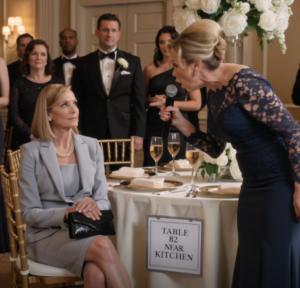
Woman at table eighty-two.
Woman beside the kitchen.
Woman who could not be reduced by where someone put her chair.
And me?
I had spent five years trying to belong to a family that measured worth by proximity to power.
Now I understand something my mother knew all along.
You do not become worthy by reaching the front table.
You are worthy at the back table.
By the kitchen.
In the corner.
At home.
In rooms where no one recognizes your name.
The chair does not make you important.
The room does not make you small.
And anyone who needs a seating chart to prove they outrank you has already told the world exactly who they are.