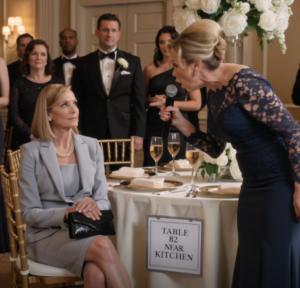
The silence that followed was not applause.
It was uncertainty.
Even Patricia seemed to feel she had stepped slightly too far.
Then Graham Ellis, standing near the stage steps, looked down at his notes.
His expression changed.
Just briefly.
A staff member had approached him during Patricia’s speech and handed him a small card.
He read it.
Then looked toward the back of the ballroom.
Toward table eighty-two.
Then he looked at Patricia.
His television smile returned, but this time there was something sharper underneath.
“Thank you, Mrs. Whitcomb,” he said smoothly, stepping forward before Patricia could continue. “That was certainly… illuminating.”
A small murmur moved through the room.
Patricia blinked.
Graham turned to the guests.
“Before we continue with the scheduled toasts, I have been asked by the event committee to make an acknowledgment that, frankly, I should have made earlier in the evening.”
Patricia frowned.
“What is he doing?” Miles whispered.
I did not answer.
Graham held the card with both hands.
“Many of you in this room are familiar with the Lane Literacy Trust.”
The room shifted.
Not dramatically.
But enough.
Heads turned.
A woman at the donors’ table sat up straighter.
A man from the Charleston Arts Council whispered something to his wife.
Patricia’s smile froze.
Graham continued.
“For more than twenty years, the Lane Literacy Trust has funded rural libraries, early childhood reading programs, scholarships for first-generation college students, and mobile book clinics across North Carolina, South Carolina, Georgia, and Tennessee.”
My heart began to pound.
I knew that trust.
Of course I did.
My mother volunteered at a library funded by it.
She had never said much about the donors.
Only that “some people give quietly because noise gets in the way of the work.”
Graham’s voice grew warmer.
“The trust’s founder has avoided public recognition for most of her life. In fact, many rooms like this one have benefited from her generosity without ever knowing she was nearby.”
Patricia’s face slowly changed.
The gold pen was no longer in her hand, but I swear I could see her reaching for control that was not there.
Graham smiled toward table eighty-two.
“Ladies and gentlemen, it is my honor to recognize Mrs. Marian Lane of Briar Ridge, North Carolina.”
The room went completely still.
Then every head turned.
Not toward Patricia.
Toward my mother.
Table eighty-two.
Near the kitchen doors.
Behind the flowers.
My mother sat with her hands folded in her lap.
For the first time all night, she looked uncomfortable.
Not embarrassed.
Uncomfortable with attention.
Graham continued.
“The same Marian Lane whose trust funded the children’s reading wing at Charleston Memorial. The same Marian Lane whose foundation supported the Lowcountry Teachers’ Fellowship. The same Marian Lane whose latest grant proposal, I am told, included significant funding for the Whitcomb Children’s Arts Initiative.”
A sound moved through the ballroom.
Shock.
Recognition.
Whispers.
The man from the Arts Council stood halfway, then sat back down.
A woman at table five said, too loudly, “That Marian Lane?”
Patricia looked as if someone had removed the floor beneath her.
Natalie turned to her mother.
“Mom?”
Patricia did not answer.
Her eyes were locked on my mother.
My mother rose slowly.
The kitchen doors swung open behind her.
A waiter carrying a tray froze mid-step.
My mother turned, smiled gently at him, and stepped aside so he could pass.
That small gesture somehow made Patricia look worse than every word said so far.
The room began applauding.
Softly at first.
Then louder.
People stood.
Not everyone.
Enough.
My mother looked horrified.
I laughed once, breathless and near tears.
Miles stared at her as if he had never seen her before.
That made anger flare inside me so sharply I almost stood.
Because I had seen her.
Always.
Patricia had simply refused to.
Graham extended a hand toward the stage.
“Mrs. Lane, if you would be willing to say a few words, I think many of us would be honored.”
My mother shook her head slightly.
I could read her face from across the room.
No, thank you.
Please, no.
But then Patricia moved.
She stepped toward Graham, still holding the microphone stand like it belonged to her.
“I believe there must be some confusion,” she said, her voice tight but smooth. “Our Marian Lane is a dear family guest, but surely—”
“Our Marian Lane?”
The words came from my mouth before I realized I had stood.
Every eye turned to me.
Miles whispered, “Avery.”
I stepped away from him.
“No,” I said quietly. “Don’t.”
My mother looked at me.
There was warning in her eyes.
Not fear.
A plea not to make pain public.
But Patricia had already done that.
She had made cruelty public and expected dignity to remain private.
Graham, bless him, held out the microphone toward my mother, bypassing Patricia entirely.
My mother took a breath.
Then began walking from table eighty-two toward the stage.
The entire ballroom watched her cross the room Patricia had tried to use against her.
She walked past the kitchen doors.
Past the late-addition tables.
Past the donors.
Past the family tables.
Past Miles.
Past me.
When she reached the stage, Graham handed her the microphone with both hands.
“Thank you,” she said softly.
The room went quiet.
Her voice was not loud.
It did not need to be.
“I did not expect to speak tonight,” she said. “And I will keep this brief because this day belongs to Natalie and Andrew, not to me.”
Natalie looked close to tears.
Andrew took her hand.
My mother turned slightly toward them.
“I wish you both a marriage where neither of you ever has to become smaller to keep peace.”
That sentence landed with such precision that several people looked at Miles.
He looked at me.
I did not look away.
My mother continued.
“As for the kind introduction, yes, I started the Lane Literacy Trust after my husband died. He believed every child should have a way out of silence, and I believed books were often the first open door.”
Her eyes moved briefly to Patricia.
“I kept my role quiet because I learned early that public generosity can become another kind of vanity if one is not careful.”
A few people murmured.
Patricia went red.
“I do not mind sitting by a kitchen,” my mother said. “Some of the finest people I have ever known have worked behind kitchen doors. My own mother cleaned homes for families who never learned her last name. I have no shame about proximity to work.”
The room held its breath.
“But I do mind when seating charts are used as weapons. I do mind when kindness is mistaken for ignorance. And I do mind when my daughter is expected to swallow disrespect because everyone else finds silence more convenient.”
My throat closed.
Miles bowed his head.
Good.
My mother looked toward me then.
Her face softened.
“Avery has spent five years trying to be gracious in rooms that did not return the courtesy. That is not refinement. That is endurance.”
No one moved.
Patricia’s mouth opened.
Graham subtly shifted the microphone cable so she could not step closer without making herself obvious.
My mother looked back at the room.
“I had intended to approve a grant through the Lane Literacy Trust supporting the Whitcomb Children’s Arts Initiative. I believed, from the proposal, that the initiative would provide arts education to children who are too often treated as if culture belongs only to those who can pay for it.”
Patricia’s face drained.
There it was.
The real blow.
Not embarrassment.
Money.
Reputation.
Boards.
The rooms Patricia actually worshipped.
My mother’s voice remained calm.
“After tonight, I will not fund that initiative under its current leadership.”
A gasp rippled through the ballroom.
Patricia whispered, “Marian.”
My mother did not look at her.
“A charity led by someone who measures human worth by table placement, accent, hometown, or wardrobe is not a charity. It is a mirror.”
The applause began before she finished lowering the microphone.
Not polite applause.
Not automatic.
Real.
People stood again.
More this time.
Graham took the microphone back gently.
“Thank you, Mrs. Lane.”
My mother nodded once and stepped down.
I moved before I thought.
I met her at the bottom of the stage and hugged her.
Hard.
In front of everyone.
She held me with one arm and whispered into my hair, “Breathe, baby.”
That was when I realized I had been holding my breath for five years.
Patricia was still standing near the stage.
Her face was pale beneath her makeup.
The guests were no longer looking at her with admiration.
They were studying her.
Recalculating.
The way people do when they realize cruelty has become socially expensive.
Natalie stood from the bridal table.
Her whole body trembled.
“Mom,” she said.
Patricia turned toward her daughter as if expecting rescue.
Natalie’s eyes were full of tears.
“Did you seat Mrs. Lane by the kitchen on purpose?”
The question was soft.
It devastated anyway.
Patricia’s face tightened.
“This is not the time.”
“It’s my wedding,” Natalie said. “Apparently it is the time.”
Andrew stood beside her.
“Natalie—”
“No,” she said, still staring at Patricia. “I want to know.”
The room went silent again.
Patricia looked around.
At the donors.
At the cameras.
At the board members.
At my mother.
At me.
She chose the wrong answer.
“I arranged the seating according to relevance.”
The words left her mouth before she understood how they sounded in a room that now knew exactly who Marian Lane was.
Someone at the back muttered, “Jesus.”
Natalie flinched.
I saw something in her break too.
Not like mine had broken over five years.
Hers broke in one moment.
Because this was her wedding, and her mother had just confessed that love in the Whitcomb family was arranged by relevance.
Miles stood at last.
Late.
So late that part of me could not even feel relief.
“Mom,” he said, voice shaking, “enough.”
Patricia turned on him.
“Do not start, Miles.”
“No.”
The word stopped her.
Maybe because he had never said it like that before.
Miles stepped away from the family table.
“For five years, Avery asked me to speak up when you insulted her. For five years, I told myself you didn’t mean it, or the timing was wrong, or it would make things worse.”
His voice cracked.
“I was wrong.”
My chest tightened.
I wanted those words.
I hated that I still wanted them.
Miles looked at my mother.
“Marian, I am sorry.”
My mother studied him.
Then nodded once.
Not forgiveness.
Acknowledgment.
Miles turned to me.
“Avery—”
I lifted one hand.
Not here.
Not now.
His face changed.
He understood enough to stop.
Finally.
The rest of the reception did not recover.
How could it?
People danced later.
Music resumed.
Dinner was served.
Cake was cut.
Photos were taken.
But the room had changed permanently.
Patricia no longer floated through it.
She moved carefully, avoided by people who had been desperate to speak to her three hours earlier.
The president of the Arts Council left before dessert.
Two foundation trustees approached my mother to apologize.
A university dean came to table eighty-two, where my mother insisted on returning because, as she said, “My soup is already there.”
But table eighty-two was not a punishment anymore.
By the end of dinner, it became the busiest table in the room.
People came to greet her.
Thank her.
Apologize.
Ask about library programs.
Ask about grants.
Ask whether she remembered funding a rural book bus in Marion County.
She did.
Of course she did.
My mother remembered the driver’s name.
She remembered the mechanic who kept the bus running.
She remembered the little girl who wrote a thank-you letter saying the bus smelled like “rain and stories.”
Patricia watched from across the ballroom as the kitchen table she had used to diminish my mother became the center of the evening.
I almost felt sorry for her.
Almost.
At ten-thirty, I walked outside onto the garden terrace.
The air was cool and damp.
The live oaks shimmered with tiny lights.
Music floated faintly through the glass behind me.
I gripped the stone railing and finally let my shoulders drop.
Miles found me there five minutes later.
He did not touch me.
That was wise.
“Avery.”
I kept looking at the garden.
“If you say you’re sorry without knowing what you’re sorry for, I will walk away.”
He swallowed.
“I’m sorry I didn’t defend your mother at dinner two weeks ago.”
I closed my eyes.
“I’m sorry I let my mother seat her by the kitchen tonight.”
My throat tightened.
“I’m sorry I kept asking you to be patient with disrespect because I was afraid of conflict.”
I looked at him then.
He was pale.
His eyes were wet.
“I’m sorry I used your grace as a shield for my cowardice,” he said.
That one hurt.
Because it was true.
I turned back toward the garden.
CONTINUE READING